The Chemist Nobody Credited: How Alice Ball Solved One of Medicine's Oldest Puzzles — and Almost Vanished From History
The Chemist Nobody Credited: How Alice Ball Solved One of Medicine's Oldest Puzzles — and Almost Vanished From History
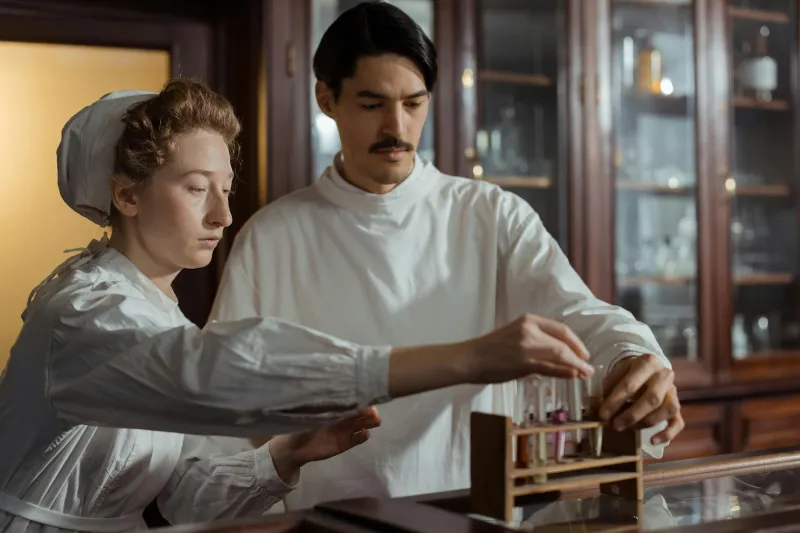
In 1915, a young woman named Alice Ball was working in a chemistry lab at the College of Hawaii, trying to solve a problem that had stumped physicians since antiquity. Leprosy — now called Hansen's disease — had been reshaping and destroying human lives for thousands of years. There was no treatment. There was barely a theory.
Alice Ball was 23 years old. She was the only Black student in her graduate program, one of very few women in the sciences at her institution, and she would be dead within two years. But before she died, she did something that changed medicine permanently — and then spent the better part of a century not getting credit for it.
Her story is the kind that history keeps trying to bury. It keeps climbing back out.
A Mind That Moved Faster Than the Doors Being Closed
Ball was born in Seattle in 1892, into a family that took education seriously enough to move where it was accessible. Her grandfather, James Presley Ball, was one of the most celebrated photographers in nineteenth-century America — a man who documented Black life and history at a time when that documentation was an act of resistance in itself. The impulse to create, to record, to contribute something lasting ran deep in the family.
Alice graduated from the University of Washington in 1914 with two degrees — one in pharmacy, one in pharmaceutical chemistry — a distinction rare for anyone at the time, and nearly unheard of for a Black woman. She was good enough at her work that the University of Hawaii recruited her for graduate study, where she became both the first woman and the first Black student to earn a chemistry master's degree from the institution.
She was 22 when she finished it.
The pace at which Ball moved through a system designed to slow her down, or stop her entirely, is one of the most quietly astonishing things about her life.
Cracking the Problem
For centuries, the only available treatment for leprosy was chaulmoogra oil, derived from the seeds of a tropical tree. Physicians had known it had some effect on the disease. The problem was delivery: the oil was so thick and caustic that patients couldn't absorb it properly when taken orally, and injecting it directly caused intense pain and skin reactions that made consistent treatment nearly impossible.
Ball's contribution was to isolate the active fatty acid esters in the oil — essentially to break the compound down into a form the body could actually use. She developed an injectable extract that worked. Patients who had been considered untreatable began to improve. Some were discharged from isolation facilities that had been their entire world.
It was a genuine breakthrough, achieved through meticulous lab work, deep chemical intuition, and a problem-solving approach that her supervisors reportedly found remarkable. She did it in a single year of focused research.
Then she got sick — likely from inhaling chlorine gas during a lab demonstration — and died in December 1916 at 24 years old.
The Erasure
What happened next is one of science history's more uncomfortable episodes.
Arthur Dean, the president of the College of Hawaii, continued Ball's research after her death and published the findings in 1920. He called the method the "Dean Method." He did not credit Alice Ball.
For nearly two decades, that attribution held. The treatment — her treatment — was used widely across Hawaii and eventually internationally, administered to thousands of patients. Arthur Dean became known for it. Alice Ball became known for nothing, because almost no one knew she existed.
The correction came slowly and incompletely. In 1922, a physician named Harry Hollmann published a paper explicitly crediting Ball and describing the actual origin of the technique. He called it the "Ball Method." His correction was largely ignored by the broader scientific community, which had already written its version of events.
It wasn't until the 1970s, when historian Kathryn Takara began researching Ball's life, that a fuller account started to emerge. In 2000, the University of Hawaii finally dedicated a plaque in her honor and established February 29th — a fitting choice, a date that only comes around every four years — as Alice Ball Day. The state legislature of Hawaii passed a resolution acknowledging her contributions the same year.
She'd been dead for 84 years.
What Her Life Reveals About Who Gets to Do Science
The question Alice Ball's story keeps raising isn't just about credit, though the credit question is damning enough. It's about access — about how she got into that lab at all, and what it cost her to stay there.
In early twentieth-century America, the path from curiosity to scientific contribution ran through institutions that were actively, structurally hostile to Black women. The fact that Ball navigated those barriers, excelled within them, and produced genuinely important work before her 25th birthday says something extraordinary about her intellect and her drive.
It also says something about how much was lost — how many Alice Balls there might have been, at every level of the sciences, whose work was never done because the door never opened far enough, or whose contributions were absorbed by someone with a more recognizable name and a cleaner path to publication.
Ball's story survived because Harry Hollmann wrote one corrective paper, because Kathryn Takara went looking, because the University of Hawaii eventually listened. It's a fragile chain of preservation, and it almost didn't hold.
Persistence Without Permission
There's a particular kind of courage in the way Ball worked — not the dramatic, public-facing courage of protest or confrontation, but the quieter, more grinding courage of continuing to show up in a space that keeps suggesting you don't belong there.
She didn't wait for the field to welcome her. She didn't wait for the culture to catch up. She went to the lab, solved the problem, and left behind work that was undeniable enough to survive even the people who tried to erase it.
That's the stranger glory here: not just that she achieved something remarkable, but that the achievement was durable enough to outlast the erasure. The Ball Method is still her name on it, 100 years later.
Some contributions are too real to disappear entirely. Alice Ball's happened to be one of them.