The Ditch Digger Who Mapped Time Itself: How William Smith Decoded Earth's Hidden Story
The Boy Who Saw Stories in Stones
In 1769, in the tiny village of Churchill, Oxfordshire, a blacksmith's nephew was born into a world that would never expect greatness from him. William Smith's father died when he was eight, leaving the family scraping by on whatever work they could find. While wealthy boys attended universities and debated natural philosophy, young William was fascinated by something far more humble: the rocks beneath his feet.
He collected fossils from local quarries, arranging them on his windowsill like other children might arrange toy soldiers. His neighbors thought it was a curious hobby for a poor boy. They had no idea he was teaching himself to read the planet's autobiography.
When Canals Became Classrooms
At eighteen, Smith apprenticed as a land surveyor — a respectable trade for someone of his station, but hardly the path to scientific immortality. Then came the canal boom. Britain was digging waterways to move coal and goods, and Smith found himself traveling the countryside, measuring and mapping for these massive earthworks.
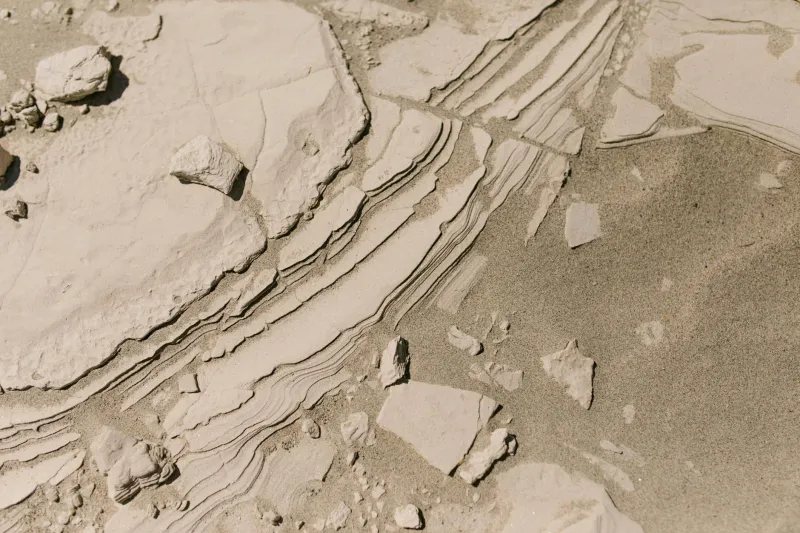
Every canal cut was like opening a book. As workers dug through hillsides and valleys, Smith saw something that escaped everyone else: the rock layers weren't random. They followed patterns. Each stratum told a story, and the fossils within them were like chapters in Earth's history.
While his colleagues saw dirt and obstacles, Smith saw time itself laid out in stone.
The Revelation That Changed Everything
Somewhere in the muddy trenches of the Somerset Coal Canal, Smith made a discovery that would revolutionize human understanding of the planet. He realized that rock formations appeared in predictable sequences across vast distances. More importantly, each layer contained distinctive fossils — what he called "organized fossils" — that could identify the age of the rock.
It was like discovering that every library book had a unique barcode. Smith could look at a fossil and tell you not just what creature it once was, but when in Earth's history it had lived.
This wasn't just geology — it was archaeology on a planetary scale.
Fighting an Empire of Privilege
Smith's breakthrough should have made him famous. Instead, it made him a target.
The Geological Society of London was a gentlemen's club where wealthy amateurs played at science between fox hunts and formal dinners. They had university degrees, family connections, and the assumption that important discoveries came from important people.
Smith was none of these things. He was a working man who spoke with a rural accent and earned his living with his hands. When he tried to share his findings, the geological establishment didn't just ignore him — they actively worked against him.
The Map That Broke Its Maker
For fifteen years, Smith poured every penny he had into creating something unprecedented: the first geological map of an entire nation. Working largely alone, he traveled thousands of miles across Britain, identifying rock formations, collecting specimens, and painstakingly documenting the underground architecture of a country.
Published in 1815, "A Delineation of the Strata of England and Wales" was a masterpiece of scientific visualization. Eight feet long and six feet wide, hand-colored and exquisitely detailed, it revealed Britain's geological structure with stunning accuracy.
The map should have made Smith wealthy. Instead, it bankrupted him.
Few people understood its significance, and fewer still were willing to pay for it. Meanwhile, members of the Geological Society were quietly using Smith's work without credit, publishing papers based on his discoveries while treating him like an invisible servant.
When Genius Meets the Gutter
By 1819, Smith's debts had overwhelmed him. The man who had mapped a nation was thrown into King's Bench Prison, a debtor's jail in London. His geological collection — the life's work that had cost him everything — was sold to pay creditors.
He emerged from prison broken and forgotten, forced to take surveying jobs in remote corners of Britain just to survive. The geological establishment continued to build careers on his foundations while he struggled to pay rent.
The Slow Dawn of Recognition
It took decades for the scientific community to acknowledge what Smith had accomplished. Gradually, geologists across Europe began to understand that his principles — what we now call biostratigraphy — had unlocked the key to reading Earth's history.
In 1831, sixteen years after his great map was published, the Geological Society finally honored Smith with the Wollaston Medal, their highest award. The ceremony was awkward — most members had spent years dismissing the man they now called "the Father of English Geology."
Smith was sixty-two, his best years behind him, his health broken by decades of struggle.
The Legacy Written in Stone
William Smith died in 1839, just as the scientific revolution he had started was reaching full flower. His methods became the foundation of modern geology, enabling everything from oil exploration to understanding climate change.
Today, every geological survey, every fossil dig, every attempt to understand Earth's 4.6-billion-year history builds on principles that a blacksmith's nephew discovered in canal cuts and quarry faces.
The irony is profound: while gentlemen scientists argued about theories in comfortable libraries, a working-class surveyor was outside actually reading the planet's autobiography. He saw what they missed because he looked where they wouldn't — in the dirt, in the mud, in the unglamorous places where Earth reveals its secrets.
Smith's story reminds us that breakthrough discoveries often come not from those with the best credentials, but from those with the clearest vision. Sometimes the most profound truths are hiding in plain sight, waiting for someone willing to get their hands dirty to uncover them.