The Scientist They Couldn't Silence: How a Former Slave Convinced America to Stop Killing Its Soil
The Boy Who Shouldn't Have Survived
In 1864, somewhere in Diamond Grove, Missouri, raiders swept through a farm and kidnapped a slave woman named Mary and her infant son. The woman was never seen again. The baby was traded back for a racehorse worth $300.
That baby was George Washington Carver, and by all reasonable expectations, his story should have ended there. Born into bondage, orphaned before he could walk, raised by the same white family that had once owned his mother—the deck was stacked so heavily against him that survival itself seemed miraculous.
But Carver had something that couldn't be stolen or traded: an insatiable curiosity about the natural world. While other children played with toys, he collected rocks, pressed flowers, and nursed sick animals back to health. The neighbors started calling him the "plant doctor" when he was barely ten years old.
The Universities That Said No
By the 1880s, Carver had managed something that seemed impossible for someone with his background: he'd gotten himself an education. But when he arrived at Highland College in Kansas, acceptance letter in hand, the administrators took one look at his skin color and told him there had been a mistake.
This wasn't unusual. It was systematic. America's higher education system was designed to exclude people who looked like Carver. But instead of giving up, he did something quietly radical: he kept applying, kept studying, kept pushing forward.
Finally, Iowa State University accepted him, making him their first Black student. He earned his bachelor's degree, then became their first Black faculty member while pursuing his master's. But even there, he ate alone. The dining hall was technically integrated, but social pressure kept him isolated.
None of this bitterness shows up in his later work. Instead, it seems to have fueled an almost supernatural focus on solving problems that affected everyone.
The South's Slow Suicide
In 1896, Booker T. Washington invited Carver to head the agriculture department at Tuskegee Institute in Alabama. What Carver found there was an agricultural disaster decades in the making.
The South had been growing cotton for so long that the soil was essentially dead. Cotton is what economists call a "soil-depleting" crop—it sucks nutrients out of the ground without putting anything back. After the Civil War, sharecroppers and small farmers kept planting it because it was the only crop they knew how to grow and sell.
But the land was dying. Crop yields were falling every year. Farmers were getting poorer. And nobody seemed to know what to do about it.
Carver saw the problem with scientific clarity: the South needed to diversify its agriculture, and it needed crops that would actually heal the soil instead of destroying it.
The Laboratory Revolution
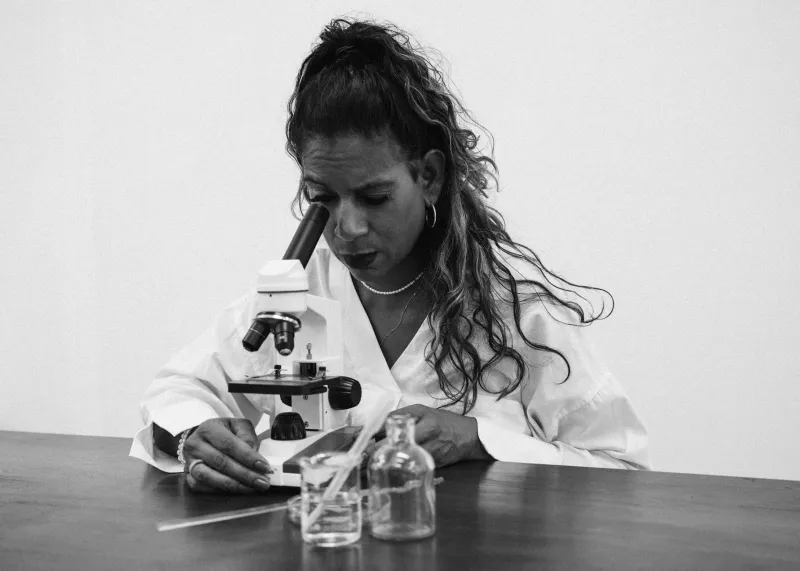
From a tiny laboratory at Tuskegee, Carver launched what can only be described as a one-man agricultural revolution. His weapons weren't political speeches or protest marches. They were test tubes, microscopes, and an almost supernatural ability to see potential where others saw waste.
He started with peanuts—a crop most farmers considered cattle feed. Through methodical experimentation, Carver developed over 300 products from peanuts: cooking oil, printer's ink, soap, shampoo, linoleum, paint, and dozens of food products.
But the genius wasn't just in the products themselves. It was in the economics. Carver was showing farmers that they could make money from crops that also restored their soil. Peanuts are nitrogen-fixing plants—they actually put nutrients back into the ground.
He did the same thing with sweet potatoes, developing more than 100 commercial products. Suddenly, farmers had alternatives to cotton that were both profitable and sustainable.
The Traveling Teacher
Carver understood that developing products in a laboratory meant nothing if farmers couldn't access the knowledge. So he did something unprecedented: he took his expertise directly to the people who needed it most.
He created a "movable school"—a wagon equipped with farming tools and educational materials that traveled throughout rural Alabama. Carver himself would climb down from the wagon and teach farmers, many of whom couldn't read, how to diversify their crops and restore their soil.
This wasn't just scientific outreach. It was economic empowerment delivered one farm at a time. Carver was literally teaching people how to save their land and their livelihoods.
The Recognition That Almost Came Too Late
For decades, Carver worked in relative obscurity. The scientific establishment largely ignored him. Agricultural journals rarely published his work. He was doing revolutionary research at a Black college in the rural South—not exactly the center of academic attention.
But slowly, the results spoke for themselves. Farmers who followed his methods saw their yields improve and their soil recover. Regional agricultural economies began to shift away from cotton monoculture toward diversified farming.
By the 1920s, even the federal government couldn't ignore what Carver had accomplished. He was invited to testify before Congress about the potential of peanut products. His presentation was so compelling that his allotted 10 minutes stretched into an hour-long session.
The Legacy in the Soil
Carver died in 1943, but his impact on American agriculture was already irreversible. The crop rotation methods he developed became standard practice. The products he invented from peanuts and sweet potatoes created entire industries. Most importantly, he had broken the South's fatal dependence on cotton.
Today, the southeastern United States produces more peanuts than anywhere else in the world. Georgia alone grows about half of all American peanuts—a $2 billion industry that exists largely because of techniques Carver developed in his tiny Tuskegee laboratory.
But perhaps his most profound legacy is philosophical. Carver proved that the most transformative solutions often come from the most unlikely sources. A man the system tried to erase ended up feeding the nation, one peanut at a time.
His life suggests something powerful about human potential: that brilliance can emerge anywhere, that the people society overlooks might be exactly the ones it needs most, and that sometimes the greatest revolutions happen quietly, in laboratories and farm fields, by people who simply refuse to accept that things have to stay the way they've always been.