The Silent Astronomer Who Counted Every Star in the Sky
The Sound of Starlight
In the basement of Harvard College Observatory, surrounded by glass photographic plates that captured distant starlight, Annie Jump Cannon worked in a silence most people would find unsettling. But for her, that quiet wasn't a limitation—it was liberation. While the world above buzzed with conversation and distraction, she could focus entirely on the patterns hidden in starlight, developing a system for understanding the cosmos that would outlast everyone who ever doubted her.
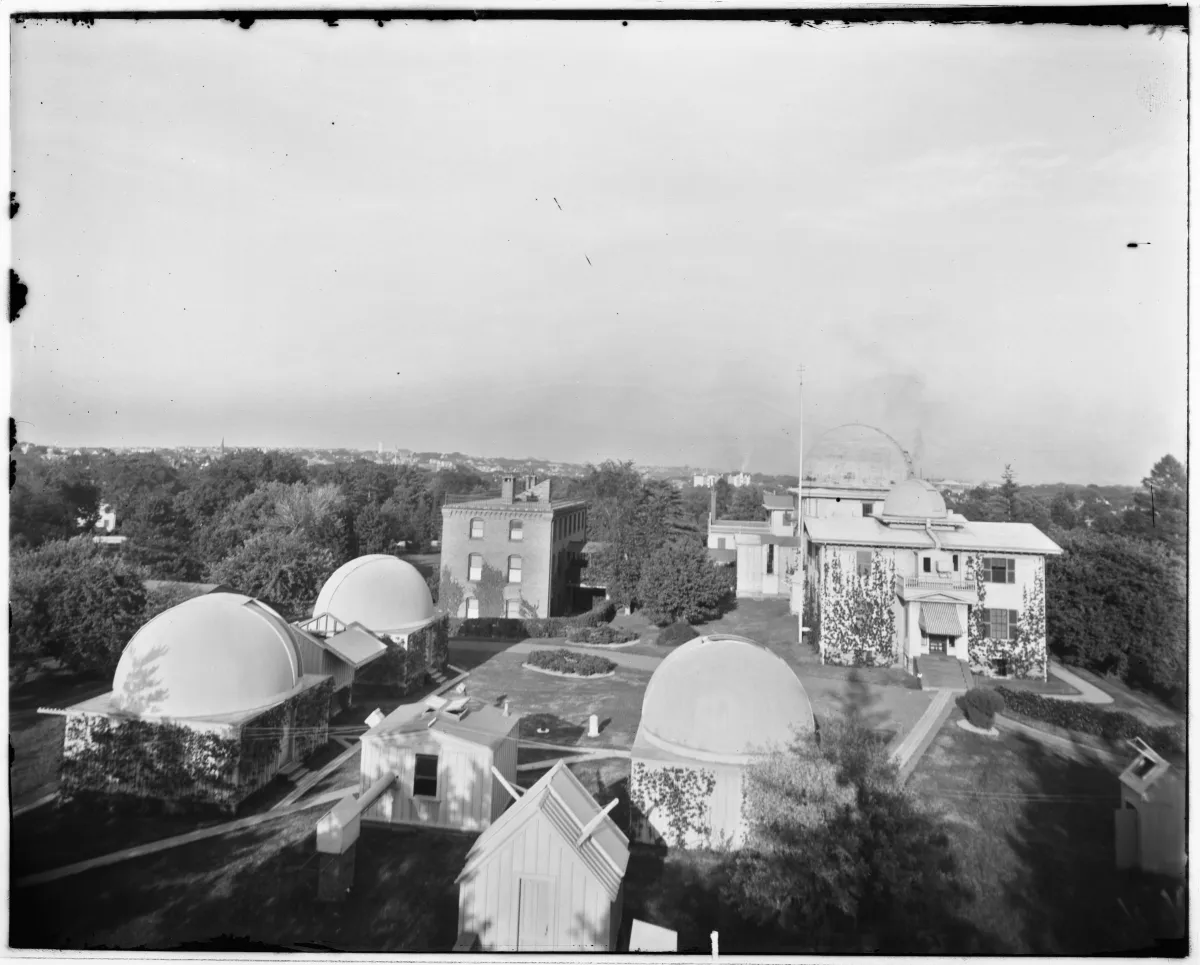 Photo: Harvard College Observatory, via hea-www.harvard.edu
Cannon didn't set out to revolutionize astronomy. She simply wanted to make sense of the overwhelming chaos of stellar data that was piling up faster than anyone could process it. What she created instead was one of science's most enduring frameworks—a way of classifying stars that transformed astronomy from descriptive observation into quantitative science.
Unlikely Beginnings Under Delaware Skies
Growing up in Dover, Delaware, Cannon seemed destined for a conventional life. Her father, Wilson Cannon, was a successful shipbuilder who encouraged his daughter's curiosity about the natural world—unusual for the 1860s, when most girls were steered away from scientific interests. But Wilson had installed something extraordinary in their family home: a trapdoor in the attic roof that opened directly to the night sky.
Evening after evening, young Annie climbed up to that rooftop observatory, learning to identify constellations and track planetary movements. Her father taught her that the stars weren't just pretty lights—they were distant suns, each with its own story written in the spectrum of light it produced. It was an education that most professional astronomers of the era never received.
When scarlet fever struck in her twenties, taking most of her hearing, many people assumed Cannon's intellectual life was over. Victorian society had little patience for disabled women, and even less for those who harbored scientific ambitions. But the illness that isolated her from ordinary social interaction also freed her from ordinary expectations.
Finding Purpose in the Photographic Revolution
Cannon arrived at Harvard Observatory in 1896, just as astronomy was undergoing a technological revolution. The new science of stellar photography was generating thousands of glass plates, each capturing the light signatures of hundreds of stars. But no one knew what to do with all this data. The plates were accumulating faster than they could be analyzed, creating a backlog that threatened to bury the entire field in unprocessed information.
Harvard's director, Edward Pickering, had an unconventional solution: hire women to process the photographic data. Women could be paid less than male astronomers—about 25 cents an hour, roughly what factory workers earned—but many had the mathematical skills and attention to detail the work required. What Pickering couldn't have anticipated was that one of these "computers," as they were called, would completely reimagine how stellar classification should work.
The Music of Stellar Spectra
Each star's light, when passed through a spectroscope, created a unique pattern of bright and dark lines—a cosmic fingerprint that revealed the star's temperature, composition, and evolutionary stage. Previous astronomers had tried to classify these spectra using complex alphabetical systems that captured every minor variation. The result was chaos: hundreds of overlapping categories that made comparison and analysis nearly impossible.
Cannon approached the problem differently. Working in her characteristic silence, she began to see patterns that others had missed. Instead of trying to catalog every variation, she focused on the fundamental sequences that connected different types of stars. She realized that stellar spectra weren't random—they followed predictable patterns based on temperature and evolutionary stage.
Her breakthrough was recognizing that stars could be arranged in a simple sequence: O, B, A, F, G, K, M. Each letter represented a temperature class, from the hottest blue giants to the coolest red dwarfs. Within each class, she added numerical subdivisions from 0 to 9. Suddenly, every star in the sky could be precisely classified with just a few characters.
Processing the Infinite
What happened next was unprecedented in the history of science: Cannon personally classified over 350,000 stars. Working methodically through thousands of photographic plates, she examined each stellar spectrum and assigned it a place in her new system. She could classify three stars per minute during her peak periods, maintaining accuracy rates that modern computers would struggle to match.
This wasn't mechanical work—each classification required judgment, pattern recognition, and deep understanding of stellar physics. Cannon was essentially teaching herself to read the biography of every star she encountered, understanding its age, composition, and evolutionary destiny from the subtle patterns in its light.
The scale of her achievement becomes clear when you consider that she was doing this work decades before electronic computers existed. Every classification was made by eye, every pattern recognized through direct observation. She was creating the first comprehensive map of stellar diversity using nothing but glass plates, a magnifying lens, and an extraordinary ability to recognize patterns.
The System That Outlasted Its Creator
Cannon's classification system, refined and published as the Henry Draper Catalogue, became the foundation of modern stellar astronomy. When the International Astronomical Union needed a standard system for stellar classification in 1922, they adopted her framework almost unchanged. Today, nearly a century later, astronomers still use her O-B-A-F-G-K-M sequence to classify stars.
But her impact extended far beyond classification. By creating a systematic way to understand stellar diversity, she enabled other astronomers to study stellar evolution, galactic structure, and cosmic distances. Her work provided the foundation for discoveries about the life cycles of stars, the structure of our galaxy, and the nature of stellar populations that wouldn't be made for decades.
The Quiet Revolutionary
What makes Cannon's story remarkable isn't just the scope of her scientific achievement—it's how she accomplished it while navigating a world that offered few opportunities for women, especially disabled women, in science. She couldn't hear the conversations that excluded her, couldn't participate in the informal networks that advanced most scientific careers. Instead, she let her work speak for itself.
In the silence of the Harvard Observatory basement, surrounded by the captured light of distant suns, Annie Jump Cannon created a language for understanding the cosmos. Her classification system became astronomy's Rosetta Stone, enabling generations of scientists to decode the stories written in starlight. She proved that sometimes the most profound insights come not from those who speak the loudest, but from those who listen most carefully to what the universe is trying to tell us.