
In a world obsessed with big data and analytics, we like to think we invented the power of numbers. But long before spreadsheets and algorithms, there were individuals who saw patterns in chaos, who counted what others dismissed, and who used mathematics to expose truths that powerful people desperately wanted to keep hidden.
These weren't your typical heroes. They were quiet, methodical, and often dismissed as obsessive. But their faith in data over dogma changed the course of human history—usually without getting any credit for it.
Florence Nightingale: The Lady with the Deadly Charts
Most people remember Florence Nightingale as the compassionate nurse with the lamp, tending to wounded soldiers in the Crimean War. What they don't know is that she was also a mathematical genius who used statistics to expose one of the British military's deadliest secrets.
When Nightingale arrived at the military hospital in Scutari in 1854, she immediately began keeping meticulous records. While other medical personnel focused on treating individual patients, she was counting everything: deaths, causes of death, sanitary conditions, supply shortages.
What she discovered was shocking. Soldiers weren't dying from battle wounds—they were dying from preventable diseases caused by horrific sanitary conditions. For every soldier who died from combat injuries, seven died from illness that could have been prevented with basic hygiene.
But Nightingale knew that simply reporting these numbers wouldn't be enough. Victorian officials were notorious for ignoring uncomfortable statistics. So she invented something revolutionary: the polar area diagram, a circular chart that made the data impossible to ignore.
Her "coxcomb" charts showed deaths from preventable disease as massive blue wedges that dwarfed the tiny red slivers representing battle deaths. The visual was so stark, so undeniable, that it forced the British government to completely overhaul military medical care.
Nightingale's statistical work saved more lives than her nursing ever did, yet most history books barely mention it.
John Snow: The Doctor Who Mapped Death
In 1854 London, cholera was killing people by the hundreds, and the medical establishment was convinced it spread through "bad air." Dr. John Snow had a different theory—and a radical method for proving it.
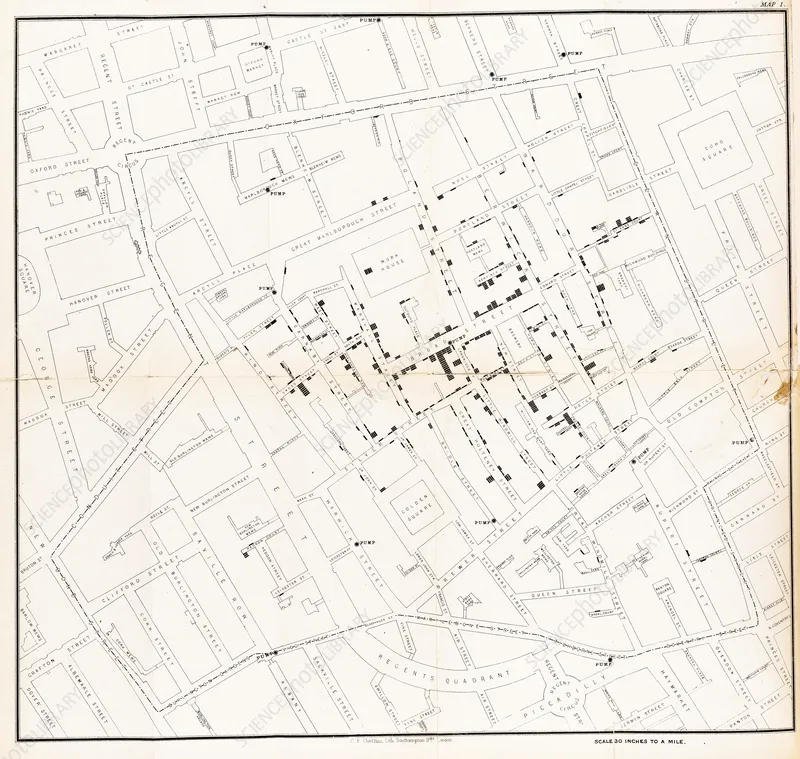 Photo: John Snow, via media.sciencephoto.com
While other doctors debated theories in comfortable offices, Snow walked the streets of Soho, knocking on doors and asking uncomfortable questions. Where did the dead person get their water? When did they fall ill? What was their exact address?
He plotted each death on a map of the neighborhood, and the pattern that emerged told a story the authorities didn't want to hear. The deaths clustered around a single water pump on Broad Street. Snow's data showed that cholera spread through contaminated water, not air—a conclusion that threatened the entire medical orthodoxy of the time.
The local government initially dismissed his findings. Even after Snow convinced them to remove the pump handle (effectively ending the outbreak), officials continued to deny that water was the culprit. It would be another 30 years before Snow's theory was accepted, long after his death.
But Snow's methodical data collection had laid the groundwork for modern epidemiology. Every contact tracing effort, every disease outbreak investigation, every public health intervention follows the template he created by simply counting deaths and mapping them accurately.
Ida B. Wells: The Journalist Who Counted Lynchings
In the 1890s American South, lynching was defended as necessary justice against Black criminals. Ida B. Wells, a young Black journalist, decided to investigate these claims by doing something radical: she counted.
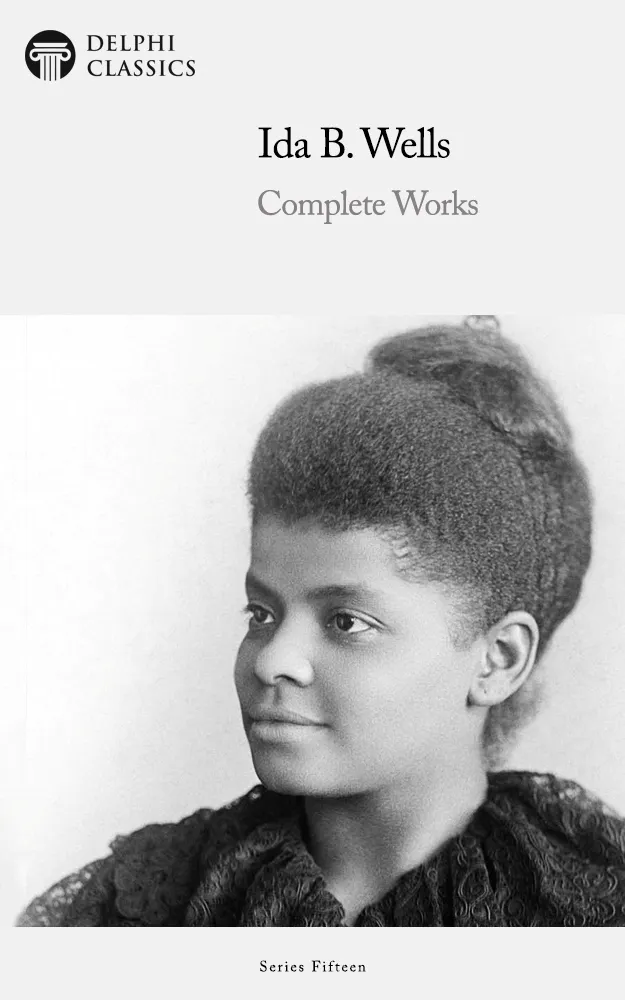 Photo: Ida B. Wells, via www.delphiclassics.com
Wells meticulously documented every lynching she could find, traveling throughout the South to interview witnesses, examine court records, and piece together the real stories behind the violence. What her data revealed was devastating.
The vast majority of lynching victims had never been accused of serious crimes. Many had been successful businessmen whose only "crime" was economic competition with white merchants. Others had simply been accused of minor social infractions or had been completely innocent.
Wells published her findings in detailed statistical reports that demolished the mythology surrounding lynching. Her numbers proved that this wasn't justice—it was terrorism designed to maintain economic and social control.
Her statistical approach to exposing racial violence was so effective that she received death threats and was forced to flee the South. But her data-driven methodology became the foundation for modern civil rights documentation, influencing organizations like the NAACP and later the Southern Poverty Law Center.
Abraham Wald: The Mathematician Who Saved Bombers
During World War II, the U.S. military had a problem: too many bombers were being shot down. Engineers studied the planes that returned from missions, noting where they'd taken damage, and concluded they needed to add armor to those areas.
Abraham Wald, a Hungarian-Jewish mathematician working for the Statistical Research Group, saw the fatal flaw in this logic. The military was only examining the planes that survived—they were ignoring the ones that didn't come back.
Wald's insight was brilliant: the areas where returning planes showed damage were actually the areas where planes could take hits and survive. The planes that were shot down had likely been hit in different areas—areas that were truly vulnerable.
Using statistical analysis, Wald determined that the military should armor the areas where the surviving planes showed no damage, because those were the spots where hits proved fatal.
This counterintuitive conclusion, based purely on mathematical reasoning, saved countless aircrews. But more importantly, Wald had identified "survivorship bias"—a logical error that continues to distort decision-making in business, medicine, and policy today.
W. Edwards Deming: The Quality Control Prophet
After World War II, American manufacturing dominated the world, and most executives saw no reason to change their methods. W. Edwards Deming, a statistician who had spent the war improving production processes, tried to convince U.S. companies that statistical quality control could revolutionize manufacturing.
American business leaders weren't interested. They were making money with existing methods and saw statistics as unnecessary complication.
So Deming took his ideas to Japan, a country desperate to rebuild its shattered economy. Japanese manufacturers embraced his statistical methods with an enthusiasm that bordered on obsession. They measured everything, tracked every defect, and used data to continuously improve their processes.
The results were spectacular. Within decades, "Made in Japan" transformed from a symbol of cheap goods to a mark of superior quality. Japanese cars, electronics, and machinery began outcompeting American products worldwide.
Only then did American companies realize what they'd missed. Deming's statistical methods had powered Japan's economic miracle, and U.S. manufacturers scrambled to learn the techniques they'd earlier dismissed.
The Uncomfortable Truth About Truth
These five individuals shared something beyond mathematical skill: they were willing to let data lead them to conclusions that challenged powerful interests and popular beliefs. They understood that numbers don't lie, even when everyone else prefers the lie.
In our current age of information overload, their stories feel more relevant than ever. They remind us that having access to data isn't enough—you need the courage to follow where the numbers lead, even when the destination makes people uncomfortable.
Most importantly, they proved that the right person asking the right questions with the right data can change the world, even if the world never learns their name.