The Secretary's Secret Empire: How One Woman's Kitchen Chemistry Became a Corporate Fortune
The Worst Typist in Dallas
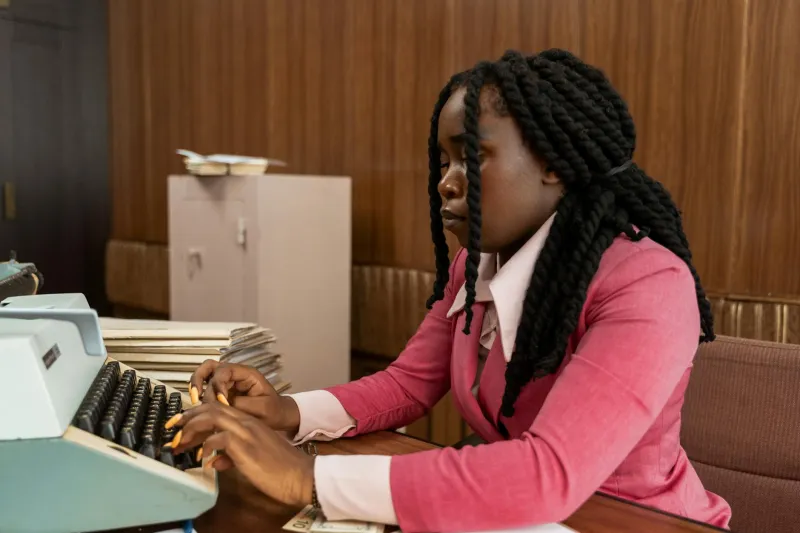
In 1951, Bette Nesmith Graham was exactly the kind of employee corporate America loved to overlook. A divorced single mother working as a secretary at Texas Bank & Trust in Dallas, she made barely enough to keep her small household afloat. Her typing skills were mediocre at best, and in an era when secretaries were expected to produce flawless documents on manual typewriters, every mistake meant starting over completely.
But Graham had a problem that would accidentally change everything: she couldn't stop making errors.
While other secretaries carefully whited out their mistakes with correction paper or retyped entire pages, Graham—who had studied art in high school—noticed something the business world had missed. Sign painters didn't erase their mistakes; they painted over them. Why couldn't she do the same?
Kitchen Table Innovation
In her tiny kitchen, Graham began experimenting with tempera paint and her son's blender. She mixed white paint to match the office stationery, thinning it until it could be applied with a small brush and would dry quickly without smudging. The first batch was crude, but it worked.
She started bringing small bottles of her homemade correction fluid to work, dabbing it over her typing errors and letting it dry before continuing. Her productivity soared. More importantly, other secretaries began asking what her secret was.
Graham called her invention "Mistake Out" and began mixing larger batches in her kitchen. Word spread through the secretarial networks of Dallas—that informal but powerful communication system that connected working women across the city. Soon, Graham was selling bottles for a dollar each, fulfilling orders from her kitchen table after her son Michael went to bed.
The Corporate Cold Shoulder
By the mid-1950s, Graham was convinced she had something bigger than a side hustle. She approached major office supply companies with her product, certain they would see its obvious value. They didn't.
IBM dismissed her outright. So did 3M. Executives couldn't understand why anyone would need such a product when proper secretaries simply didn't make mistakes. The few meetings she managed to secure were brief and condescending. One executive reportedly told her that if her product was really necessary, his company's research department would have already invented it.
The rejection stung, but Graham had bills to pay and orders to fill. She kept mixing correction fluid in her kitchen, gradually improving the formula and building a customer base one secretary at a time.
Building an Empire in Secrecy
What corporate America failed to grasp, Graham understood instinctively: the modern office was changing. Electric typewriters were becoming standard, producing cleaner text that made errors more noticeable. Carbon copies meant that mistakes were multiplied across multiple documents. The pressure for perfect typing was intensifying just as the workforce was expanding.
Throughout the late 1950s and early 1960s, Graham operated her growing business from her home while maintaining her day job. She renamed the product "Liquid Paper" and began marketing through office supply catalogs and word-of-mouth networks. Her son Michael, who would later find fame as a member of The Monkees, helped fill bottles and ship orders.
The business grew organically, driven entirely by demand from working women who understood the product's value in ways that male executives couldn't. Graham never advertised in major publications or pursued venture capital. She simply filled orders, reinvested profits, and gradually expanded her operation.
The Fortune Nobody Saw Coming
By 1968, Graham had moved production out of her kitchen and into a proper facility. Liquid Paper was selling millions of bottles annually, distributed through office supply stores across the country. She had created not just a product, but an entire industry category.
The same companies that had dismissed her invention were now scrambling to create competing products. But Graham had built something more valuable than a formula—she had built trust with her customers and established distribution relationships that took decades to develop.
In 1979, nearly three decades after she first mixed paint in her kitchen blender, Graham sold Liquid Paper Corporation to Gillette for $47.5 million plus ongoing royalties. The deal made her one of the wealthiest self-made women in America.
The Accidental Revolutionary
Graham's story reveals something profound about innovation and opportunity. She didn't set out to build a corporate empire or challenge gender barriers in business. She simply had a problem that needed solving and the practical intelligence to solve it.
Her success came not from disrupting established markets, but from serving an overlooked customer base with an undervalued need. While male executives focused on big-picture office automation, Graham paid attention to the daily frustrations of working women.
The irony is perfect: a woman considered inadequate at her secretarial job created a product that made millions of secretaries more effective. The kitchen-table operation that major corporations couldn't take seriously eventually outperformed their own research departments.
Graham died in 1980, just months after selling her company. She left behind not just a fortune, but proof that the most transformative innovations often come from the most unexpected places—and that sometimes, being bad at your job is the first step toward creating something extraordinary.