He Dodged the Front Lines and Drew the Most Honest War Art America Ever Saw
Bill Mauldin's grand strategy for surviving World War II was, by his own admission, essentially cowardice dressed up as initiative. He was eighteen, underweight, and deeply unimpressed with the infantry rifle he'd been handed when the Army drafted him in 1940. Combat was not part of his plan. Getting himself assigned to a newspaper was.
 Photo: Bill Mauldin, via pixnio.com
It worked. And in working, it produced something nobody had expected — a body of cartoon work so brutally honest about the experience of frontline soldiers that it became arguably the most important visual record of the American soldier in World War II. Not bad for a kid who was mostly trying to stay alive.
The Scrawny Kid With the Sketchpad
Mauldin grew up in New Mexico and Arizona, the kind of scrappy, sun-baked upbringing that didn't offer many obvious paths to artistic fame. He had been drawing since he was a child, the way some kids just are — compulsively, instinctively, filling margins and notebooks with faces and figures. He took a cartooning correspondence course as a teenager and attended the Chicago Academy of Fine Arts briefly before the draft interrupted everything.
The Army put him in the 45th Infantry Division. Mauldin looked at his fellow infantrymen and looked at the rifle in his hands and made a calculated decision: he was going to make himself too useful as a cartoonist to be sent somewhere he might get shot. He pitched the division newspaper, the 45th Division News, on running a regular cartoon strip. They said yes.
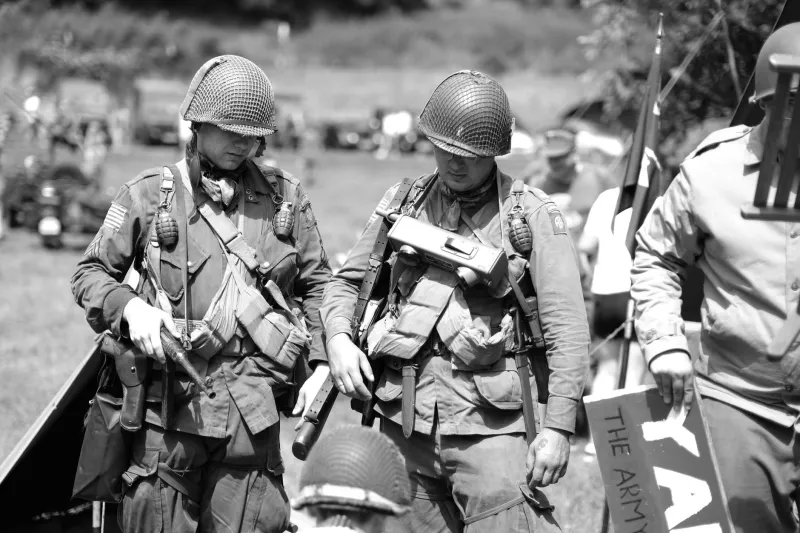
 Photo of 45th Infantry Division, via Wikidata/Wikimedia Commons
It was, as career pivots go, one of the more consequential ones in American cultural history.
Willie and Joe Show Up
The characters Mauldin created for his strip weren't heroes. That was the whole point. Willie and Joe were filthy, unshaven, perpetually exhausted infantrymen who slouched through the war with a bone-deep weariness that no propaganda poster would ever have approved. They complained. They scrounged. They were sardonic about officers, skeptical of glory, and deeply attached to small comforts — a dry foxhole, a hot meal, a moment of quiet.
They were also, to the hundreds of thousands of American soldiers who encountered them in the pages of Stars and Stripes — which eventually picked up Mauldin's work for distribution across the European theater — absolutely, precisely real.
Mauldin hadn't drawn Willie and Joe from imagination. He had drawn them from the men around him, and eventually from the front lines themselves, because despite his original plan to stay safely behind a drawing board, he ended up accompanying infantry units into combat to get his material right. His sketchpad went where the fighting went. The drawings that came back were not the work of someone watching from a comfortable distance.
One of his most famous cartoons showed a cavalry officer putting his jeep out of its misery with a pistol shot — a direct parody of the romanticized war imagery that official channels preferred. Another depicted a soldier reading a letter from home while sitting in a devastated landscape so bleak it made the domestic cheerfulness of the letter feel almost cruel. There was no glory in these drawings. There was only the grinding, exhausting, darkly funny truth of what the war actually felt like from the bottom up.
The General Who Hated Him
Not everyone appreciated the honesty. General George S. Patton, who had very specific ideas about how soldiers should present themselves and very little patience for anything that undercut military discipline or martial dignity, despised Mauldin's work with a passion that was almost admirable in its intensity. He called the cartoons subversive. He tried to have Stars and Stripes banned from his command.
 Photo: George S. Patton, via docs-experto.com
Patton demanded a meeting with Mauldin in 1945 to express his displeasure in person. Mauldin went. He was twenty-three years old, a sergeant, sitting across from one of the most feared generals in the United States Army. He did not back down. He explained, politely but firmly, that his cartoons were for the enlisted men — that they were a pressure valve, a way of laughing at the misery rather than being crushed by it — and that the soldiers who were actually fighting the war seemed to find them useful.
Patton did not change his mind. The cartoons kept running anyway.
A Pulitzer Before He Was Old Enough to Order a Beer
In 1945, at twenty-two years old, Bill Mauldin won the Pulitzer Prize for Editorial Cartooning. He was the youngest person to receive that particular honor at the time. The citation recognized what soldiers had already known for two years: that Willie and Joe had captured something essential and true about the American experience of World War II that no official account had managed to touch.
After the war, Mauldin struggled — as many veterans did — to figure out what came next. His particular genius had been forged in a very specific crucible, and peacetime cartooning didn't always make the same use of it. But he found his footing again, eventually winning a second Pulitzer in 1959 for a cartoon about the Soviet labor camps that carried the same unflinching clarity as his wartime work.
What Avoidance Built
The genuine strangeness of Mauldin's story is that his most significant achievement was born from an act of creative self-preservation. He didn't set out to document the American soldier's experience for posterity. He set out to stay alive and stay comfortable, and the drawing was his best available tool for doing so.
But somewhere between the division newspaper and the front lines he kept visiting for material, something shifted. The work became more than a survival strategy. It became a vocation — and then a record that outlasted the war, the men who fought it, and the general who tried to shut it down.
Leadership, it turns out, doesn't always look like charging forward. Sometimes it looks like a skinny kid with a sketchpad finding a way to tell the truth that nobody else had the angle to see.