She Grew Up in the Fields. She Built the Future in a Garage.
The Address Nobody Wanted to Admit
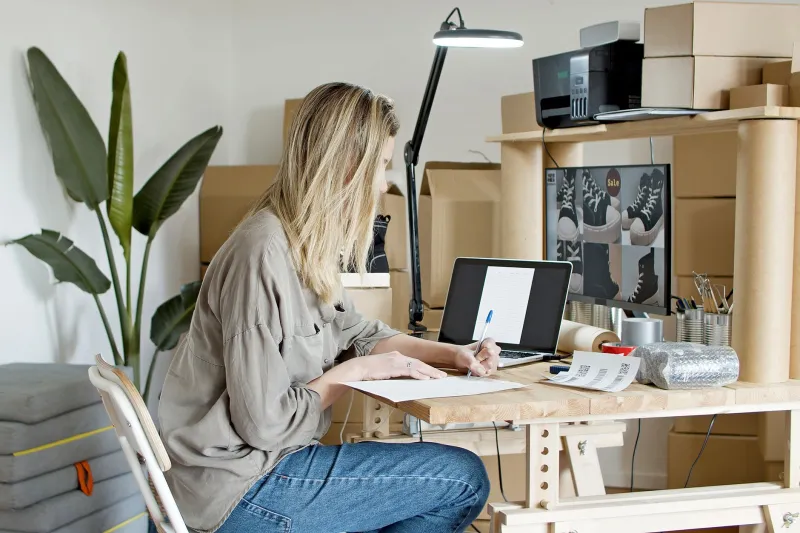
There's a particular kind of silence that settles over a garage at two in the morning. No air conditioning. The smell of motor oil and old cardboard. A single extension cord running power to a laptop that's held together with a strip of electrical tape. For most people, that's a picture of failure. For Sandra Reyes, it was the only office she could afford — and it turned out to be exactly the right one.
Sandra grew up following the harvest. Her parents, Ernesto and Consuelo, were part of the seasonal migration that quietly feeds America while remaining almost entirely invisible to it. Strawberries in Watsonville. Onions in the Central Valley. Blueberries in Oregon when the California season dried up. The family moved eight times before Sandra started high school. She attended four different elementary schools, learned to make friends fast, and learned even faster that nobody was coming to hand her a head start.
"I knew exactly what the floor looked like," she said years later. "I'd been living on it my whole life. That actually makes you fearless in a strange way. You already know you can survive the worst outcome."
What Poverty Teaches That Business School Doesn't
She was the first in her family to graduate from a four-year college — a state school, not an Ivy, paid for through a combination of Pell Grants, work-study shifts in the campus cafeteria, and a stubbornness that her professors alternately admired and found exhausting. She studied computer science because it seemed like the most direct road out of the fields. She wasn't wrong.
After graduation, she landed a mid-level role at a logistics software firm in San Jose. It was decent work, and it paid more than her parents had ever earned in a single year. But she kept noticing the same problem that nobody around her seemed interested in solving: the agricultural supply chain — the invisible network that moves food from field to grocery shelf — was running on technology that hadn't meaningfully changed since the 1990s. Farmers were still managing inventory on spreadsheets. Distributors were still losing product to spoilage because nobody could see what was in transit in real time. The people who grew America's food were being failed by the same systems that were supposed to serve them.
She knew that world intimately. Her colleagues did not.
The Garage Years
She quit her job on a Tuesday. She moved back into her parents' house in Salinas — a decision that required swallowing a particular kind of pride — and set up a workstation in the detached garage where her father stored his tools. Her mother brought her coffee at midnight. Her father, who had never owned a computer and remained quietly baffled by what his daughter was building, occasionally leaned in the doorway and watched her type.
She had $4,200 in savings. She had no investors, no co-founder, and no connections to the venture capital world that had funded most of her former colleagues' ambitions. What she had was an obsessive firsthand knowledge of the problem she was trying to solve, and a willingness to spend her weekends driving up and down Highway 1 talking to farm operators, trucking dispatchers, and produce buyers who had never been asked for their opinion by a tech founder before.
That listening, it turned out, was the product.
The platform she built wasn't technically revolutionary. It was operationally precise. It addressed the exact friction points that the people actually doing the work had been complaining about for years — the ones that Silicon Valley had overlooked because Silicon Valley had never spent a summer picking strawberries.
The Moment the Room Changed
The first real investor meeting was a disaster. She showed up in business casual to a Sand Hill Road conference room full of men in fleece vests who asked questions that made it clear they had never considered agriculture as a market worth disrupting. One of them asked, with genuine puzzlement, whether farmers even used smartphones.
She smiled and told him that the farm operators she'd spoken to were running six-figure operations from their phones, had been doing so for years, and that the venture capital industry's ignorance of that fact was precisely why the opportunity was still sitting there unclaimed.
She didn't get a check that day. But she got a second meeting. And eventually, she got funded — not by the fleece-vest crowd, but by a smaller firm with agricultural roots that understood immediately what she'd built and why it mattered.
Growth was not overnight. It was grinding and incremental and occasionally terrifying. There were payroll gaps she bridged with credit cards. There was a product launch that failed publicly enough to generate an unflattering industry newsletter item. There was a competitor, better-funded and worse-informed, that tried to replicate her model and couldn't figure out why it didn't work the same way.
It didn't work the same way because they hadn't grown up in the fields.
What the Fields Actually Gave Her
The company crossed the billion-dollar valuation threshold quietly, without a splashy press release. Sandra was characteristically unbothered by the milestone itself. What she talked about more readily was the hiring pipeline she'd built — a deliberate effort to recruit engineers and product managers from agricultural communities, from community colleges in the Central Valley, from the same kind of backgrounds that venture capital had historically overlooked.
"The people who understand this problem are the people who lived it," she said. "That's not charity. That's just good product development."
Her father still lives in Salinas. The garage has been cleaned out. Her mother keeps a framed magazine cover on the kitchen wall, the one that called her daughter one of the most important figures in agricultural technology. Ernesto occasionally tells people about it, though he remains quietly unsure what agricultural technology actually means.
What it means, more or less, is this: a woman who spent her childhood invisible to the economy built a company that made the economy pay attention. She used the thing that was supposed to hold her back as the thing that pushed her forward. And she did it from a garage that smelled like motor oil and old cardboard, at two in the morning, when the rest of Silicon Valley was asleep.